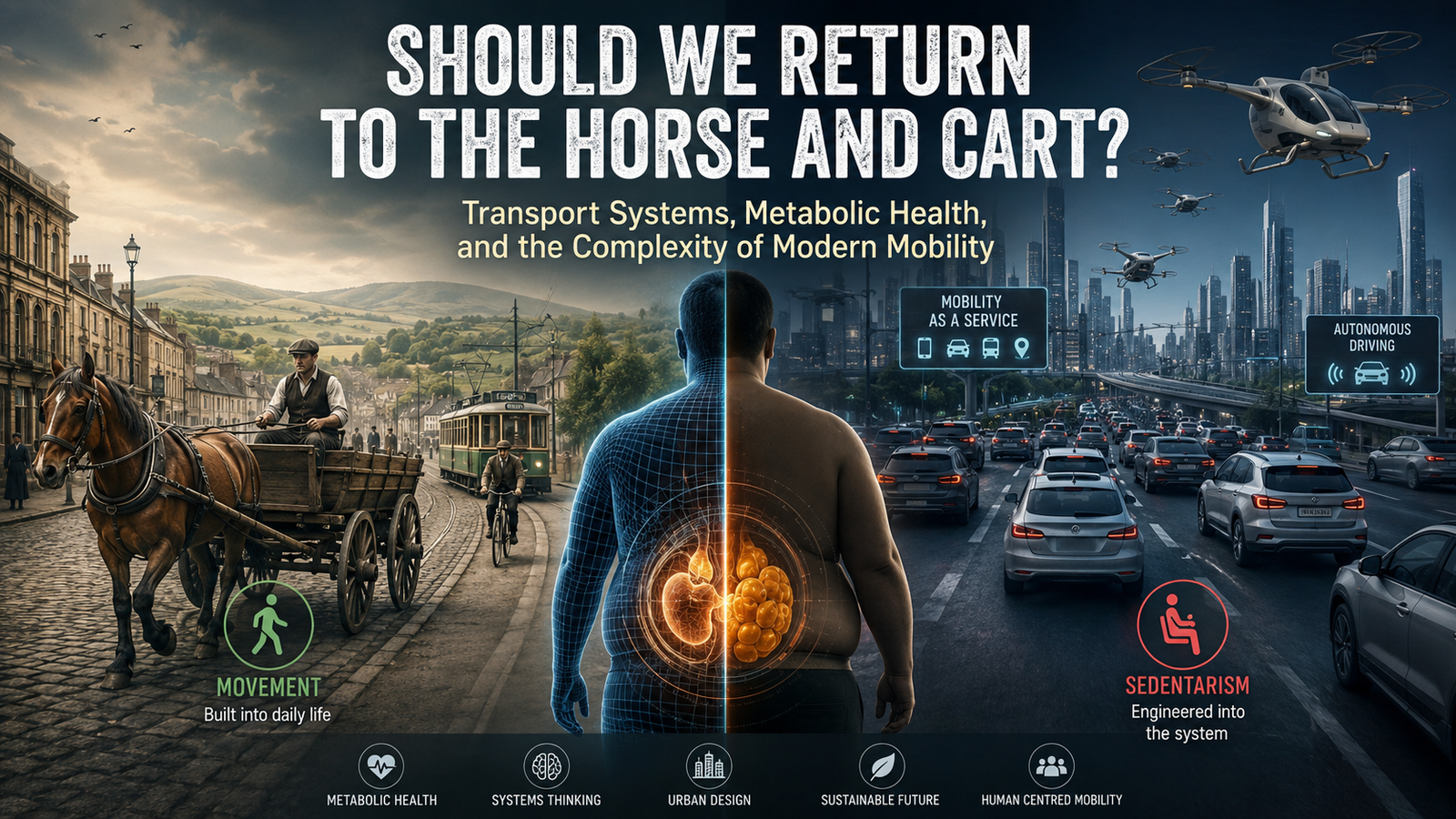
The global rise in metabolic disorders, particularly those associated with visceral adiposity, represents one of the most significant public health challenges of the modern era. Conventional explanatory models, centred on caloric imbalance and individual behavioural choice, provide an incomplete account of this phenomenon. While energy intake and structured exercise remain important variables, they fail to adequately explain the consistency and scale of metabolic dysfunction observed across diverse populations and environments (Swinburn et al., 2011; Hall et al., 2012). This paper advances an alternative, systems-oriented framework, proposing that modern transport technologies constitute a primary environmental determinant of metabolic health. Specifically, it is argued that the progressive removal of habitual movement and mechanical load from daily life—driven by mechanised transport systems—has fundamentally altered the physiological operating conditions under which human metabolism functions. Drawing on interdisciplinary evidence from physiology, anthropology, epidemiology, transport studies, and space medicine, the paper develops a unified model linking reductions in movement frequency, mechanical load, and activity distribution to impaired metabolic regulation. Section 1 establishes the theoretical foundation, demonstrating that skeletal muscle activity, non-exercise activity thermogenesis (NEAT), and mechanical loading are critical regulators of glucose metabolism, lipid utilisation, and fat distribution (Levine, 2005; Hamilton et al., 2007; Després, 2012). Section 2 reconstructs pre-mechanised human activity patterns, showing that movement was historically continuous, load-bearing, and structurally embedded within daily life (Pontzer et al., 2012; Raichlen et al., 2017). Subsequent sections examine the transition to mechanised transport, highlighting how automotive systems, urban sprawl, and convenience technologies have introduced prolonged and repeated sedentary exposure (Frank et al., 2004; Ding et al., 2014). These changes are shown to suppress skeletal muscle activation, impair lipid metabolism, and reduce circulatory function, contributing both to chronic metabolic dysfunction and acute vascular risks such as deep vein thrombosis (Hamilton et al., 2007; Cannegieter et al., 2006). Epidemiological evidence demonstrates consistent associations between transport mode, sedentary time, and central adiposity, with active transport linked to reduced metabolic risk and passive transport associated with increased obesity prevalence (Flint et al., 2014; Sallis et al., 2016).
The analysis is extended through examination of microgravity and bed rest studies, which provide a boundary condition illustrating the physiological consequences of extreme reductions in mechanical load. These findings reinforce the conclusion that mechanical load is an essential, non-optional input for maintaining metabolic stability (Hamburg et al., 2007; Fitts et al., 2000). Modern sedentary environments are thus conceptualised as partial analogues of reduced-load systems, operating chronically rather than acutely. From a systems architecture perspective, the paper argues that contemporary transport environments reflect a structural design failure: they optimise convenience and throughput while externalising biological cost. Movement, once integral to transport, has been systematically engineered out of daily function and replaced with passive mobility. This shift transforms the human body from an active participant in transport into a passive load, with downstream consequences including insulin resistance, visceral fat accumulation, and vascular dysfunction. The central conclusion is that visceral adiposity and metabolic disease are not solely the result of individual behaviour, but are emergent properties of environmental architecture. Transport systems, urban design, and micro-level convenience technologies collectively shape movement patterns, mechanical load exposure, and sedentary time. Effective intervention therefore requires a reorientation from individual- level solutions toward structural redesign. The paper concludes by proposing an architectural framework for both policy and individual practice. At the societal level, this includes the development of compact, walkable environments, integration of active transport infrastructure, and preservation of movement within transport systems. At the individual level—particularly for those with pre-diabetes—it involves the deliberate reconfiguration of daily movement pathways to restore frequent muscular activation and mechanical load. In summary, this work reframes metabolic health as a systems problem. It argues that the widespread removal of movement and load through modern transport technologies has created a biologically incompatible environment, and that restoring these inputs through architectural redesign is essential for long-term metabolic stability.