The global rise in visceral adiposity constitutes a major public health challenge, commonly attributed to individual behavioural factors such as diet and physical inactivity. This study advances a complementary systems-level thesis: that visceral fat accumulation is, in significant part, an emergent property of modern mobility systems. Framed around the provocative question—“Should we return to the horse and cart?”—the paper employs this formulation not as a literal proposal, but as a heuristic device to interrogate the extent to which contemporary transport has eliminated the necessity for physical movement from daily life.
Drawing upon interdisciplinary evidence from transport studies, public health, behavioural science, and systems engineering, the analysis traces the historical transition from predominantly active and shared mobility systems—characterised by walking, cycling, trams, and buses—to widespread private car ownership. Particular attention is given to the progression from zero-car to single-car households and subsequently to multi-car configurations, alongside the expansion of driving participation from predominantly male drivers to near-universal adult adoption. Extending further, the study identifies a contemporary phase in which even children are increasingly incorporated into mechanised mobility through devices such as electric scooters, thereby embedding reduced physical activity across the life course.
The paper further evaluates the modern vehicle as a layered technological system that progressively reduces physical and cognitive engagement. The transition from manual to automatic transmissions, the widespread adoption of safety technologies such as the Anti-lock Braking System, and the proliferation of advanced driver assistance systems (ADAS) are shown to enhance safety and convenience while diminishing driver effort. Concurrently, in-car digital ecosystems and climate-controlled environments insulate occupants from external conditions, suppressing non-exercise activity thermogenesis (NEAT) and reinforcing sedentary exposure.
A central contribution of the study is the introduction of “infrastructure friction”—encompassing pot-holes, roadworks, and traffic congestion—as a critical determinant of metabolic outcomes. Contrary to the assumption that inefficiencies in transport systems might promote physical activity, the analysis demonstrates that such friction instead prolongs sedentary time, increases stress, and exacerbates time displacement effects. Traffic congestion, in particular, is associated with elevated cortisol levels and associated pathways of visceral fat accumulation. Thus, both highly optimised and degraded transport systems are shown to converge in producing adverse metabolic effects through distinct but reinforcing mechanisms.
The study also examines emerging mobility technologies, including electric vehicles (EVs) and autonomous transport systems. While EVs offer clear environmental benefits, they do not address the underlying behavioural and physiological mechanisms of sedentarism. The progression toward autonomous vehicles and Mobility-as-a-Service (MaaS) platforms is argued to risk further eliminating residual physical engagement, transforming mobility into an entirely passive experience.
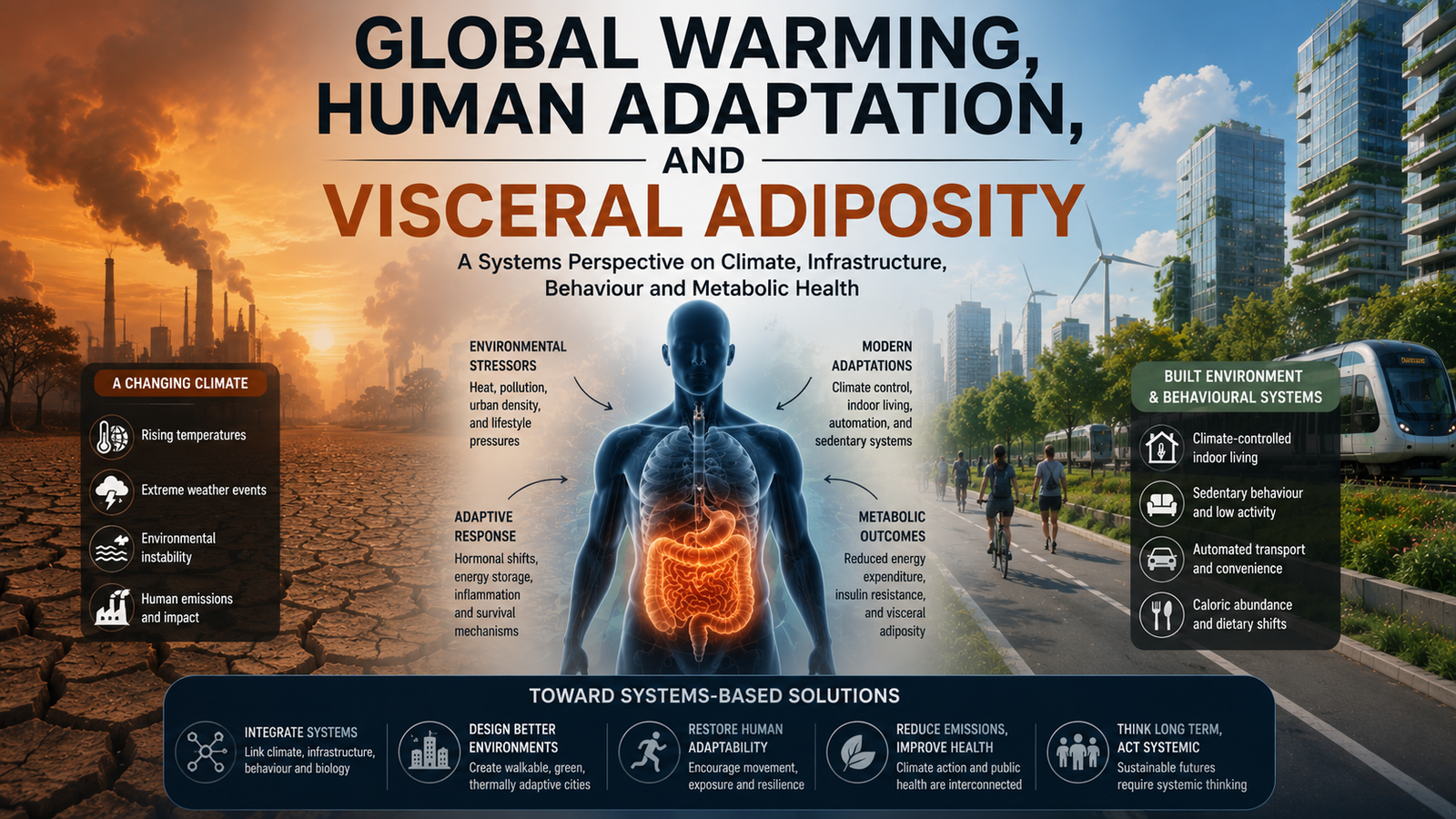
These dynamics are conceptualised as “metabolic externalities”—unintended physiological consequences arising from the optimisation of transport systems for speed, safety, and convenience. This framing shifts the analytical focus from individual responsibility to systemic causation, aligning with perspectives advanced by the World Health Organization, which emphasise the role of built environments in shaping health behaviours.
In response, the paper proposes a framework for metabolically aware mobility systems, integrating interventions at individual, household, organisational, and infrastructural levels. These include strategies to reintroduce obligatory movement into daily travel, redesign urban environments to support active mobility, and embed health-oriented metrics within transport system performance evaluation.
In conclusion, the study argues that while a literal return to the horse and cart is neither practical nor desirable, the systems it represents—characterised by enforced physical engagement and distributed activity—offer critical insights. The central challenge for modern societies is not to abandon technological progress, but to reintegrate movement into mobility systems that have systematically engineered it out. Visceral adiposity, in this light, is not merely a consequence of individual choice, but a predictable outcome of transport systems that have prioritised efficiency at the expense of human metabolic health.